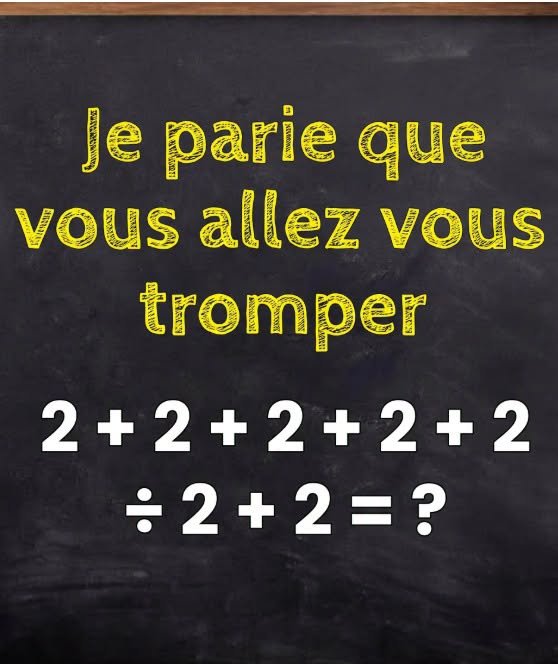


Let’s return to our expression: 2 + 2 + 2 + 2 + 2 ÷ 2 + 2
No parentheses here. So we first identify the division:
➡️ 2 ÷ 2 = 1
We substitute into the expression:
2 + 2 + 2 + 2 + 1 + 2
Now, we add them up calmly from left to right:
2 + 2 = 4 → 4 + 2 = 6 → 6 + 2 = 8 → 8 + 1 = 9 → 9 + 2 = 11
The correct answer is 11. Not 7, not 12 — 11 .
Why is our brain so easily tricked?
Three common mistakes lead us astray. First, we read too quickly: we skim the expression and add everything up without considering the order of operations. Second, we tend to “invent” parentheses where they don’t exist, which throws off the entire calculation. Finally, many people mistakenly believe that multiplication always comes before division—when in fact they have exactly the same function.
The trick to never making a mistake again
Before diving headfirst into an expression, take a moment to identify all the multiplications and divisions. Solve them first, in the order they appear. Only then should you move on to the additions and subtractions. If an expression seems confusing, mentally add parentheses to visualize the hierarchy: it makes all the difference.
The next time an “easy” calculation taunts you on social media, you’ll know exactly what to do.