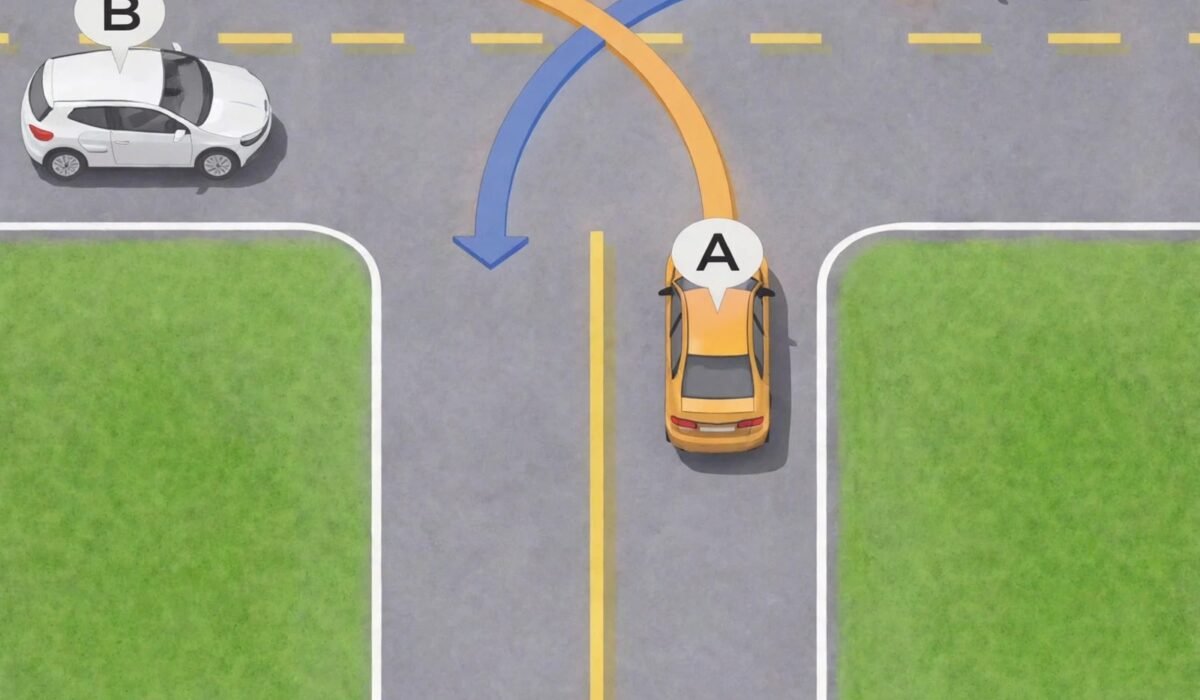


You’re driving peacefully through a residential neighborhood. Suddenly, an intersection appears: no traffic lights, no signs, no road markings. And a car arrives at the same time as you. We’ve all experienced that moment of confusion. And yet, there’s a clear rule for navigating it without stress—and without a collision. You just need to know it.
What the Highway Code actually says
When an intersection has no signage — no “Stop” sign, no “Yield” sign, no traffic light — one rule automatically applies: priority to the right . This rule alone determines the order of passage.
In practical terms, here’s how it works:
– Look to your right. – If a vehicle is coming from that direction, let it pass. – If there is no one on the right, it is your turn to proceed.
It seems simple. But in the reality of traffic, things quickly become complicated.
The T-junction: a situation that sows confusion
The T-junction is particularly tricky. Visually, it seems as if one lane is “main” and the others should give way. It’s a natural reflex… but often wrong.
Even without a priority sign, the right-of-way rule still applies . It doesn’t matter if the street appears wider or busier. It’s not the appearance of the road that matters, it’s the signage—or lack thereof.

Imagine three cars arriving simultaneously at this famous T-junction. Each driver looks to her right. The one with no one to her right goes first. The other two wait, then repeat the same process. The order naturally reorganizes itself, without a hitch.
Page 1 of 2